
How To Get Faster At Running For HYROX
BTW- if you prefer listening to this as a podcast rather than reading then listen here. Otherwise, read on (warning you though…it’s a long blog post, but you WILL learn something new from it!)….
Running makes up a HUGE part of HYROX. The requirement for HYROX is 8×1km runs (+ Roxzone distance). If you can improve your running by just 5s per 1km that is AT LEAST 40s faster race time just like that clicks fingers.
However, we have the added complexity re running for HYROX in that every run comes before or after a functional station, meaning your ability to maintain your running pace while fatigue accumulates can have a huge impact on your overall race time.
So, how do you actually get faster at running for HYROX?
The answer isn't to repeatedly go out and try to run a fast 5km. Equally, doing all of your running at the same easy pace probably isn't going to maximise your improvement either.
Every run in your programme should have a purpose. To explain this further let me delve into some science as to what is happening in your body as you try to run faster!
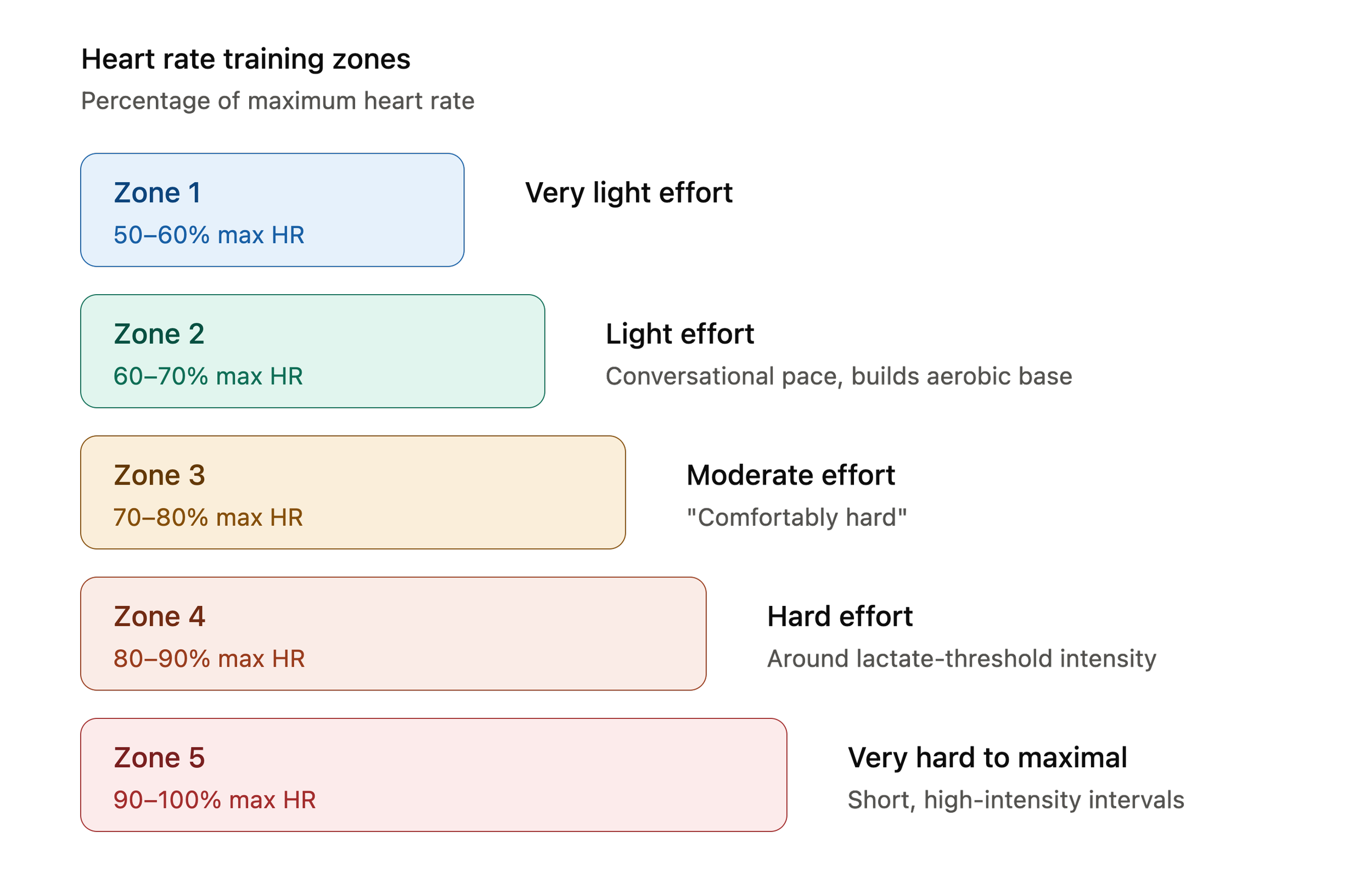
Understanding heart rate training zones
Heart-rate training zones can help us understand the intensity we're working at and the physiological demands we're placing on our body.
It's important not to think of these zones as completely separate boxes. Your intensity can drift between zones, so it's better to think of them as a sliding scale.
As a simple guide (varying sources will list these percentages slightly different. The general premise is that as effort increases, % of max HR also increases):
Zone 1 – 50–60% max HR: Very light effort.
Zone 2 – 60–70% max HR: Light effort. Generally conversational and commonly used to develop your aerobic base.
Zone 3 – 70–80% max HR: Moderate or "comfortably hard" effort.
Zone 4 – 80–90% max HR: Hard effort, around your lactate-threshold intensity.
Zone 5 – 90–100% max HR: Very hard to maximal effort, such as short, high-intensity intervals.
You can see the above info displayed in the image. These percentages aren't perfect. Unless you undergo laboratory testing, you won't know exactly where your individual physiological thresholds sit.
Testing such as lactate-threshold or VO2 max testing can provide more accurate information, but for most recreational athletes, a fitness watch or heart-rate monitor can still be a useful tool.
More importantly, if you're consistently using the same device, you can compare your data against your own previous data and look for trends over time.

What happens as running intensity increases?
As your running intensity increases, your working muscles require more oxygen.
The faster you run, the harder your muscles have to work to maintain that pace. Your heart rate rises, your breathing rate increases and fatigue gradually increases because you're asking more from your body.
At lower intensities, you're able to maintain your pace for much longer.
But eventually, you begin approaching your physiological thresholds.
This is where understanding LT1 and LT2 becomes useful.
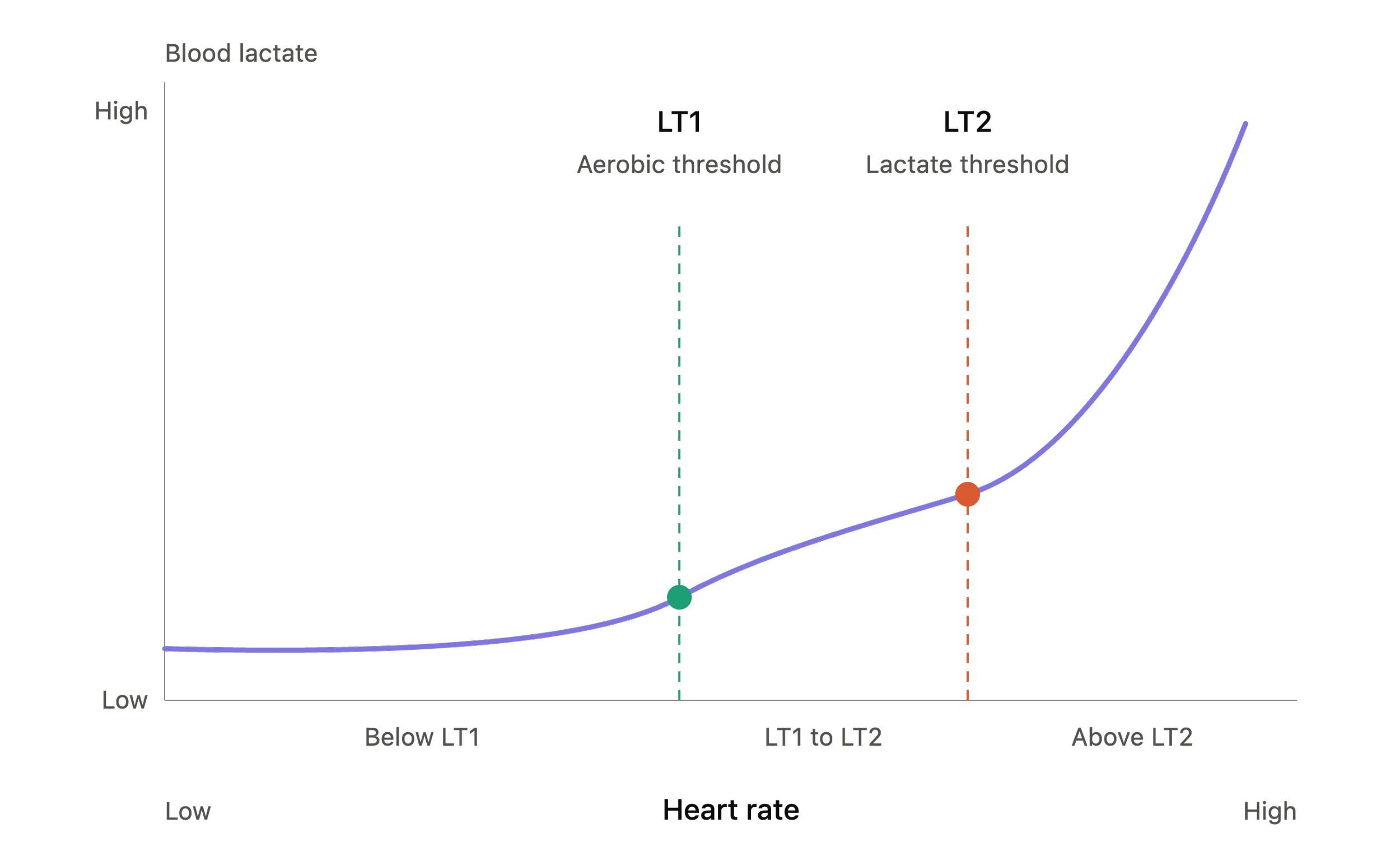
LT1, LT2 and Lactate Threshold explained
Your lactate threshold describes the relationship between exercise intensity and the rate at which lactate is produced and cleared. It can also be used in conjunction with heart rate (as this is a measure of intensity). I have produced the graph above to show the relationship of an increase in blood lactate and an increase in heart rate and how it leads to your LT1 & LT2. This data would be different for every individual, but it useful for us to see it presented this way.
There are two useful thresholds to understand:
LT1 – Aerobic Threshold
LT1 is the point where blood lactate begins to rise above baseline levels.
It sits around the upper end of your easier aerobic work, and as you move beyond LT1, your reliance on carbohydrate for fuel begins to increase.
Between LT1 and LT2, you're generally working within what is often referred to as the tempo range.
LT2 – Anaerobic Threshold
LT2 occurs at a higher intensity.
At this point, lactate begins accumulating more rapidly and fatigue increases significantly, making the intensity increasingly difficult to sustain.
One important clarification: lactic acid itself isn't directly responsible for your muscles becoming fatigued. However, blood lactate is a useful marker of the increasing metabolic stress associated with harder exercise.
Continue increasing the intensity beyond this point and you'll move towards Zone 5 and eventually your VO2 max.
VO2 max refers to the maximum amount of oxygen your body can take in and utilise during intense exercise. It's an important indicator of cardiorespiratory fitness and essentially represents the ceiling of your aerobic system.
Why Threshold Training can make you A faster runner
Threshold running involves running at a controlled but hard intensity around your lactate threshold.
The aim over time is to improve the pace you can sustain before fatigue begins to rise rapidly. This will shift your LT1 and LT2, so that you become capable of running faster before your body experiences the same level of metabolic stress and fatigue.

What does A threshold running session look like?
‘This is all useful to know, Hannah. However what does a threshold running session actually look like?’ Well, there are many ways of executing a threshold running session. A well-trained runner may be able to sustain an intensity around threshold for a significant period, whereas a beginner may only manage relatively short periods.
This is why threshold work is often broken into intervals and these intervals can range from doing it as set times or doing it as distance (eg as 400m/800m repeats).
An example- 4 x 10 minutes hard/controlled running with 2 minutes easy recovery between efforts. Depending on your fitness level, you could alter your work to rest ratio here. Threshold sessions generally sit around 15-30 mins in duration.
Breaking the work into intervals allows you to accumulate more quality running without your pace deteriorating significantly.
You can also include continuous tempo runs.
Tempo running would generally sit slightly below a true threshold effort. Think approximately 6–7/10 RPE, compared with around 7–8/10 for harder threshold work.
Both can have a place within your programme.
How do I know what pace to run?
Unless we did lab testing on you, we can’t know for sure where your LT1 and LT2 is and at what given pace. However, you can get to know your HR data through your fitness device/HR monitor and start to understand more about what HR you can maintain. In saying this, even then day to day your HR can fluctuate due to other factors (sleep, stress, menstrual cycle).
Instead, you can combine heart rate with RPE and the talk test on a given day to figure out your pace.
The Talk Test
Around LT1, you should still be able to speak relatively comfortably in sentences or short blocks.
As you approach LT2, speaking becomes much harder. You might only be able to get out a few words at a time.
RPE
Using a 1–10 Rate of Perceived Exertion scale:
Tempo/LT1 work: approximately 6–7/10.
Threshold/LT2 intervals: approximately 7–8/10.
Maximal work: 9–10/10.
As you gain more running experience, you'll become much better at judging these intensities and understanding which paces you can realistically sustain.

Don't make every run hard
If hard running makes us faster, why not just run hard all the time?
Because harder isn't always better.
Easy aerobic running still has an important role within a well-rounded programme.
This is where Zone 2 training comes in. Zone 2 training can help improve your cardiovascular system by increasing stroke volume and blood volume, allowing your heart to deliver oxygen-rich blood to the working muscles more efficiently.
It can also contribute to increased mitochondrial density and function, improved fat oxidation and increased capillary density.
In simple terms, your body becomes better at producing energy aerobically and delivering oxygen to the muscles. Zone 2 is also a good recovery tool.
Why you don’t always need to go all-out
Going all-out will most likely lead to higher fatigue levels which could impact your subsequent training sessions in days to come. It also has a big impact on your nervous system as well as causing injury risk and technique breakdowns with your running. You can still gain the physiological benefits from sitting slightly below an all out effort.
Don’t get me wrong though…theres a time and place for ‘all out’ such as races!

HYROX isn’t just running, so should I do some compromised running?
Yes. You deffo should be. This is because different HYROX stations will have a different impact on our heart rate. For example, a BBJ will raise the HR a lot more than a farmer carry which will increase lactate, increase fatigue and increase the demands on the body more so. This will then likely lead to you having to slow down on your run due to your body not being able to meet the physiological demands that resulted from a spike in HR from BBJ.
If you train these stations though eg get used to having to do runs into stations like BBJ then you can get more efficient on the station so as to complete them within a good time still, but less of an impact on heart rate, less lactate, less fatigue and therefore can maintain your runs.
Training efficiency and technique on stations is so important for this reason. I recommend you do at least 1 session per week where you focus on a technique element of your training.
So how might our weekly training look?
You need to firstly consider your starting point. Advice for a beginner will differ to advice for an intermediate/ experienced racer. If you are a beginner (at running) and just starting out then you may just begin with one run per week and within this run you might do a mix of zone 2 (WU) and then maybe work towards LT 2/ tempo pace with some intervals and then you might finish with zone 2. This way, you are getting a mix of benefits of the zone 2 easier sessions and the harder sessions.
My advice to you would largely depend on what your focus is for your current training block. If you are brand new to hyrox and you are also a beginner at running then I’d probably just get you doing that session and then 1 session that is HYROX based and we start to introduce some runs + station work (but without accumulating too much distance because we dont wanna overdo it if you are a beginner runner and a beginner hyroxer).
Week by week with some consistency you may then build up and you can then add in an additional hard session so that you do 1 fully zone 2 per week and 1 harder run and 1 compromised HYROX session, working on your weaknesses.
For those who have done a HYROX, I would encourage you to think about what your current block training outcome goal is. This is what I do with my clients. This might also look like 1 easy zone 2, 1 harder run (intervals/ hills/track style session), 1 compromised hyrox session, but you may also add in another threshold interval based session. If you are someone who tends to get niggles if you do too much mileage then you could always do this session on a bike.
Biggest advice is to start with less sessions and slowly increase mileage week by week. Include your compromised runs accumulate runs into your weekly mileage. If you are feeling any niggles come on then It is your body way of suggesting you may be doing too much too soon and so alter accordingly.
Can I get faster at running without running?
To a degree…you can get the benefits of zone 2 and also threshold based intervals on other modalities, but you do wanna get used to time on feet where possible. However, if you get inured or niggles then swapping to the bike is a good idea to aim to maintain your fitness.

Summary
There is so much more that I could write on this topic, but this blog post is a good starting point.
Within this blog post, we have learnt:
What LT1, LT2 and Lactate Threshold is
Why we should include tempo runs and/or threshold runs and what they are
Why zone 2 running is important
Why speed sessions are important
Why we also need to do some compromised running
How we need to alter our training plan depending on our fitness levels and experience
I hope you found this blog post useful! If you are interested in coaching then send me a text and we can discuss coaching options. I offer running and HYROX coaching plans (with many of my HYROX programmes including a run programme free of charge!).
You can also check out my podcast here. I have a load of educational content on there to help you level up your knowledge and performance !
