
Strength training is an important part of preparing for HYROX. But what exercises should you be doing? How many sets and reps should you aim for? And how often should you include strength training in your weekly programme?
In this blog, I'm going to break down how I approach strength training for HYROX athletes.
Before we get started, when I refer to strength training throughout this blog, I'm talking about dedicated strength sessions. These are separate from your HYROX or strength and conditioning sessions, where you might combine lifting with HYROX-specific movements.
Side note- this is a lengthy blog post. Grab yourself a cuppa, sit down, relax and have a read!

1. Understanding Progressive Overload
Before looking at specific exercises and training structures, it's important to understand one of the key principles of strength training: progressive overload.
Progressive overload is the process of gradually increasing the demands placed on your body over time to stimulate improvements in strength.
There are several ways you can achieve this, including:
Increasing the weight you lift.
Increasing the number of repetitions.
Adding additional sets.
Reducing rest periods (although this isn't necessarily my priority when developing maximal strength).
The aim is to continually challenge your muscles so that they adapt and become stronger.
However, there's one thing I want to emphasise: good technique should never be sacrificed to lift heavier weights.
Increasing the load at the expense of your lifting technique isn't productive. You may not be targeting the intended muscles effectively, and you're potentially increasing your injury risk.
Sometimes, lifting a lighter weight with better execution will provide a much better training stimulus than simply adding more weight to the bar.
2. What Strength Exercises Should You Do For HYROX?
The exercises I would recommend depend largely on the individual athlete, their current strength levels and their HYROX performance goals.
For example, if you're struggling to push a sled, developing lower-body and posterior-chain strength should be a priority.
However, if you're already relatively strong and can comfortably manage the sled, your strength training may be more focused on maintaining that strength while allowing sufficient recovery for your conditioning sessions.
This is why I don't believe there is one perfect strength programme for every HYROX athlete.

2.1 Sled Push As A Strength Exercise
One thing I'd encourage you to consider is using the sled push as a strength exercise in its own right.
Rather than always incorporating sled pushes into high-intensity conditioning sessions, you can dedicate time to heavier sled work and gradually increase the load over time.
This provides an opportunity to practise pushing above race weight, focus on technique and develop the strength required to move heavier loads. This also helps prepare you for a HYROX race whereby sleds are feeling particularly heavy!
You're also less fatigued than you would be during a typical HYROX session, allowing you to focus more on the quality of each effort.
2.2 Include A Compound Exercise
Compound exercises recruit multiple muscle groups and joints to complete a movement.
Examples include:
Squats.
Deadlifts.
Push presses.
Bench presses.
I generally recommend including at least one compound movement in your strength sessions.
They allow you to train multiple muscle groups simultaneously, are time-efficient and provide an opportunity to lift challenging loads.
For example, incorporating barbell back squats into your programme can help develop lower-body strength, trunk stability and the strength required to perform wall balls.
2.3 Hinge Movements: Developing Your Posterior Chain
Hinge exercises are movements initiated through the hips, primarily targeting the posterior chain, including your glutes, hamstrings and back.
My preferred exercise here is the Romanian deadlift (RDL).
You can perform these using a barbell, dumbbells or a trap bar.
Developing posterior-chain strength is particularly beneficial for HYROX athletes:
Sled push: stronger glutes and hamstrings can contribute to greater force production and leg drive.
Sled pull: stronger glutes, hamstrings and back muscles help develop the strength required to pull the sled.
Running: posterior-chain strength contributes to running performance and the ability to tolerate training demands.
Other options include conventional deadlifts and hip thrusts. RDLs generally place a greater emphasis on the hamstrings.
2.4 Unilateral Strength: Training One Side At A Time
Unilateral strength training involves working one side of the body independently.
Examples include:
Lunges.
Step-ups.
Single-leg leg press.
Why is this important for HYROX?
Running is a unilateral activity, meaning you're repeatedly loading one leg at a time. HYROX also places considerable physical demands on the body, and developing strength on both sides is important.
Unilateral exercises can help identify and address strength discrepancies between limbs, develop stability and improve your ability to produce force on one leg.
This is particularly useful if you've previously experienced injuries or have identified strength imbalances.
2.5- Don't Neglect Your Calves And Soleus
Calf and soleus strengthening should be an important consideration for HYROX athletes, particularly those completing higher volumes of running.
HYROX involves a significant amount of repetitive impact, and your lower legs need to be able to tolerate these demands.
Exercises I'd recommend including are:
Standing calf raises (straight knee).
Seated or bent-knee calf raises (soleus emphasis).
Developing calf and soleus strength can help improve lower-leg capacity and is an important part of managing the demands placed on your Achilles tendon, feet and calves.
2.6 Upper-Body Strength
At a minimum, I'd recommend including exercises that target your chest, shoulders and back.
These muscle groups all contribute to different HYROX stations:
Chest: pressing strength when performing burpee broad jumps.
Shoulders: farmer's carries and the pressing component of wall balls.
Back: sled pulls and rowing.
You don't necessarily need to spend hours training your upper body, but neglecting it would be a mistake.
Summary- Putting It All Together
If you're completing one dedicated strength session per week, I'd recommend making it a full-body session.
See image below that shows how you might programme the above advice into one full body session.
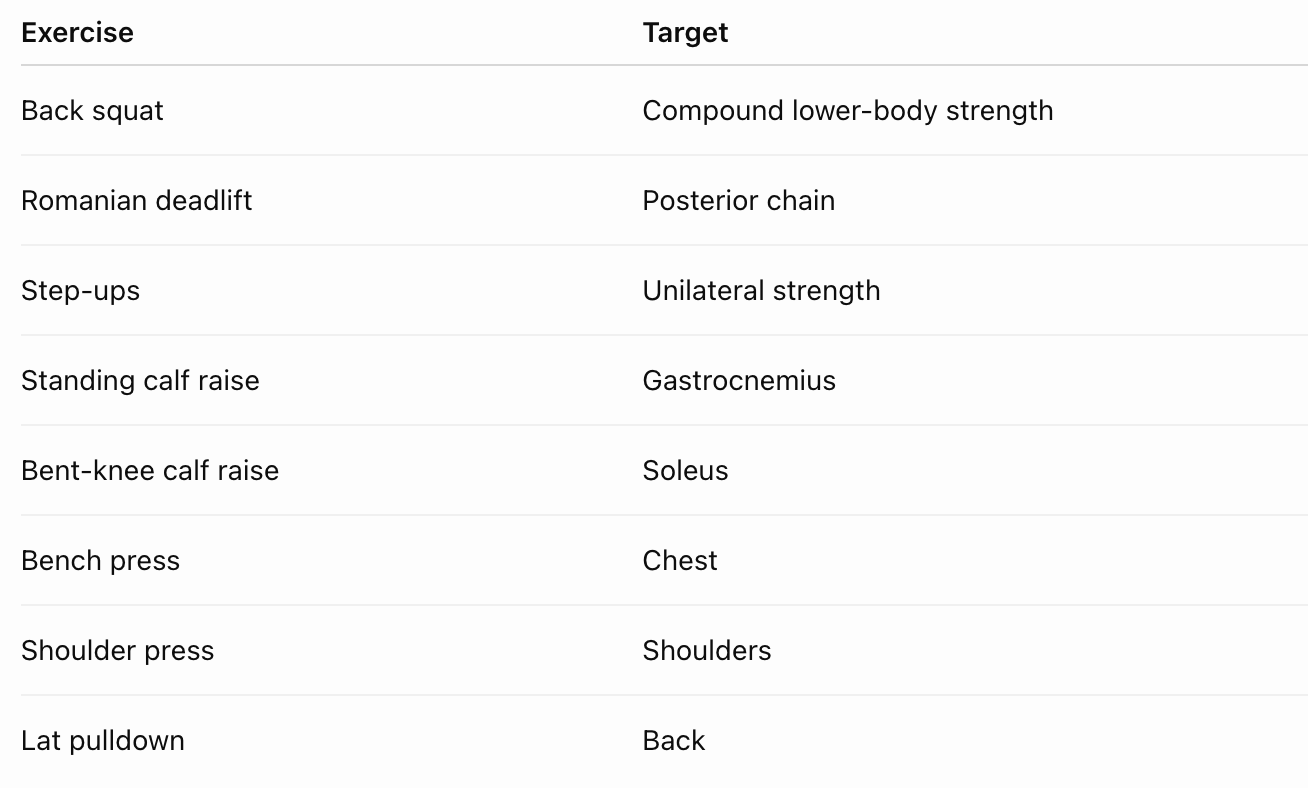
3. Should You Do One Or Two Strength Sessions Per Week?
If you're relatively new to strength training, start with one full-body session.
If you already have some strength training experience and have sufficient time for additional training, I'd recommend considering two sessions per week.
There are a couple of ways you could structure this:
Two full-body sessions.
One upper-body session and one lower-body session.
Personally, I prefer the upper/lower split.
I find it allows me to get more out of my lifts, because I can dedicate more time to a particular area without trying to squeeze everything into one session.
It also gives me more flexibility to include accessory exercises that target specific areas of the body.
For example:
Example Upper-Body Session
Pull-ups.
Bench press.
Overhead press.
Lat pulldown.
Triceps extensions.
Biceps curls.
You could also incorporate HYROX-specific exercises such as farmer's carries and sled pulls.
This session would target your back, chest, shoulders, biceps and triceps.
Example Lower-Body Session
Back squats.
Romanian deadlifts.
Calf raises.
Bent-knee calf raises.
Leg extensions.
Hamstring curls.
You can also use this session to focus on specific weaknesses.
For example, if you identify that your glutes are a weaker area, you could incorporate additional glute-focused exercises.
Ultimately, experiment with different structures and find what works best alongside your HYROX-specific training.

4. What Rep Ranges Should You Use For HYROX Strength Training?
There isn't one magic rep range for building strength.
Research demonstrates that a variety of rep ranges can improve strength, providing the load, effort and progressive overload are appropriate.
However, if your primary goal is maximal strength, heavier loads and lower rep ranges generally have an advantage.
For my HYROX athletes, I like to use a mixture depending on the exercise and what we're trying to achieve.
Main compound movements
For exercises such as squats and deadlifts, I might programme:
4–5 sets of approximately 5 reps.
3–4 sets of 6–8 reps.
The aim is to lift a challenging weight while maintaining good technique.
I often encourage athletes to leave approximately two repetitions in reserve (RIR). In other words, finish the set knowing you could have completed another two good-quality repetitions.
This provides an effective training stimulus without unnecessarily pushing every set to failure.
Rest periods
For heavier compound exercises, I'll generally allow around 90 seconds to two minutes of recovery, or longer if required.
Remember, the purpose of your dedicated strength session is to develop strength, not turn every exercise into a conditioning workout.
HYROX athletes already complete plenty of conditioning, so there's no need to compromise the quality of your strength work by rushing between sets.
Accessory exercises
For accessory movements, I'll often use slightly higher rep ranges.
For example:
Leg extensions: 3 × 8–12.
Hamstring curls: 3 × 8–12.
Chest press: 3 × 8–12.
Lat pulldowns: 3 × 8–12.
These exercises allow you to target specific muscle groups and build additional training volume.
5. Combining Strength Exercises With HYROX Movements
There are also occasions where I'll deliberately combine a strength exercise with a HYROX movement.
For example:
Back/front squats → Wall balls.
Heavy deadlifts → Sled pull.
Pull-ups → Farmer's carries.
However, I'd generally classify this as HYROX-specific strength endurance or conditioning rather than pure strength development.
There's a place for both in your programme.
We want to develop maximal strength, but we also need to prepare our bodies to perform HYROX movements under fatigue. Combining exercises in this way can help develop that specific capacity.
6. Identify Your Weaknesses And Programme Accordingly
There are plenty of ways to strength train for HYROX, and your programme should reflect your individual needs.
I'd encourage you to think about your previous HYROX performances, or your current training if you haven't raced yet.
Ask yourself:
Which stations do I find the hardest?
Where do I lose the most time?
Do I struggle with the sled push or sled pull?
Do my shoulders fatigue during farmer's carries or wall balls?
Am I lacking general lower-body strength?
Are there any noticeable strength imbalances?
Once you've identified your weaknesses, you can start working backwards and selecting exercises that address them.
This is where individualised programming becomes particularly important.
Two athletes might both be preparing for the same HYROX race, but their strength programmes could look very different depending on their training history, current abilities and performance goals.
7. Don't Forget Your Nutrition: Protein And Strength Gains
You can have the best strength programme in the world, but if you're not consuming enough protein and energy to support your training, you're potentially limiting your progress.
Protein plays an important role in muscle repair, recovery and muscle protein synthesis, which is the process through which your body builds and repairs muscle tissue.
For athletes looking to develop strength and build muscle, a useful daily protein guideline is:
1.6–2.2g of protein per kg of body weight.
For example, if you weigh 70kg, this would equate to approximately 112–154g of protein per day.
Where you sit within this range will depend on factors such as your overall calorie intake, training demands and individual tolerance.
Your total calorie intake is also important. If you're consistently under-fuelling, you may struggle to recover and maximise your strength adaptations.
Make sure your nutrition supports the training you're doing.
Final Thoughts: Strength Training For HYROX
There's a lot to consider when programming strength training for HYROX, but hopefully this blog has given you a better understanding of how to approach it. This isn’t the only way you can approach strength training. There are many ways you can get stronger for HYROX, but this tends to be the approach I take= UNLESS, I need to tailor a clients strength programming in a way whereby this format doesn’t benefit them as much as another approach. This is where having a coach that tailors the workouts for you and your weaknesses is beneficial.
To summarise:
Aim for at least one dedicated strength session per week.
If you're completing one session, make it full body.
If you're completing two sessions, consider an upper/lower split.
Prioritise compound movements alongside hinge and unilateral exercises.
Don't neglect your calves, soleus and upper-body strength.
Use a variety of rep ranges depending on the exercise and training goal.
Apply progressive overload while maintaining good technique.
Adjust your strength work around your HYROX-specific training.
Identify your weaknesses and programme accordingly.
Consume sufficient protein and calories to support your training and recovery.
Above all, make sure you're lifting challenging weights that provide a stimulus for improvement, without compromising your technique.
You don't need to spend hours in the gym to make progress. Even a 40-minute session incorporating two upper-body and two lower-body exercises is a great starting point.
Something is better than nothing.
Need Help Programming Your Strength Training?
If you're a HYROX athlete looking to get stronger but aren't sure how to structure your strength training, I can help.
Through ‘Burgon Fitness’, I offer individualised coaching and strength programming designed around your training history, current abilities and performance goals.
You don't necessarily need full coaching, either. If you'd simply like me to programme one dedicated strength session per week to complement your existing HYROX training, that's something I can do too. Contact me here to discuss.

